Caversham, Reading:
Our Lady of Caversham
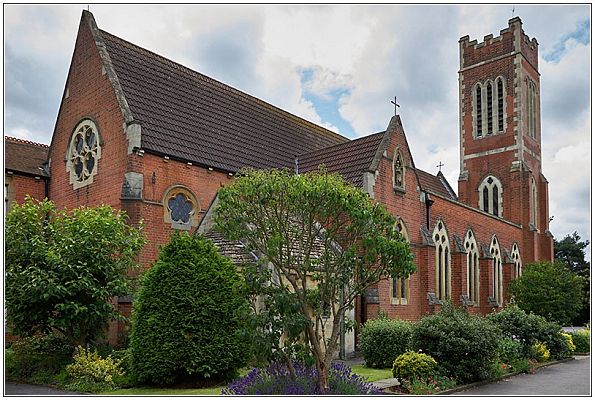
In her chapel adjoining Our Lady and St. Anne’s Catholic Church, 2 South View Ave., Caversham, Reading RG4 5AB. Caversham, suburb of Reading, Berkshire county, lies one hour West of London. Original plated with silver, i.e. black, life size, burnt at the stake in 1538. Present statue about 15th century also life size, oak.
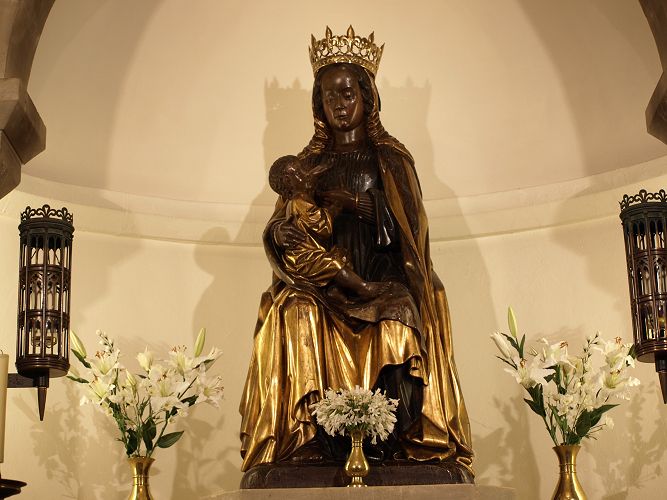
- She was plated with silver, which turns black quickly as it oxidizes.
- She stood “in such a wild place”*1 and was associated with a venerated oak tree at the top of Priest Hill and a sacred well (St. Anne’s Well), which was said to cure many afflictions. This closeness to nature and sacred water is typical for ancient Black Madonnas.
- In the 13th century she was second among English Madonnas only to Our Lady of Walsingham. Very few white Madonnas became that famous in the Middle Ages.
The original Madonna, her shrine, and her memory were so thoroughly destroyed and razed during the English Reformation that we can’t even say exactly where her church stood, much less what the history of the statue was. St. Ann’s well too was lost for many years. It was restored early this century, but still runs dry.
What we do know about the shrine is that it experienced a heyday in the 13th century. Pilgrims visiting the shrine, from the south, would first find a stopping place on Caversham Bridge across the Thames, at St. Anne’s Chapel. It too has long gone. The present church is a ten minute walk from the Thames.
Medieval worship centered around a wonderful, jewel-encrusted, crowned statue of the Virgin, but the shrine also housed an important collection of relics that had been offered to Our Lady: In 1106, Duke Robert of Normandy presented the spearhead that pierced Christ’s side on the Cross. He had brought it back from the First Crusade and it became the principal relic of England.*2 There was also a piece of the rope with which Judas hung himself, the daggers that killed King Henry and St. Edward, etc. Her chapel was filled with ex voti such as crutches and replica of body parts whose healings were attributed to Our Lady of Caversham.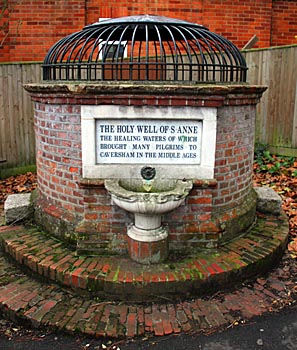
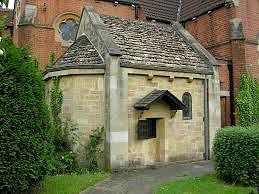
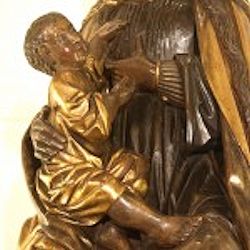
The revival of this shrine began in 1897, the year following the foundation of the Catholic parish of Our Lady and St. Anne, made possible by the freedom of religion act of 1829. In the Marian year 1954, the present chapel was built and this beautiful, Northern European, nursing Madonna bought in an antique shop in London. Since the original was crowned, the new Lady of Caversham too received a crown in 1996.
________________________________________
Footnotes:
*1 According to a pamphlet available in her present church.
*2 It may have been that given by Duke Robert, though it was said to have been brought to Caversham by an angel with one wing - probably a statuette which held the relic.Sources: http://www.ourladyandstanne.org.uk/the-shrine/history/
https://insearchofholywellsandhealingsprings.wordpress.com/2015/05/19/once-a-place-of-pilgrimage-st-annes-well-caversham/
http://www.berkshirehistory.com/villages/caversham.html
http://oxoniensia.org/volumes/1981/haigh.pdf